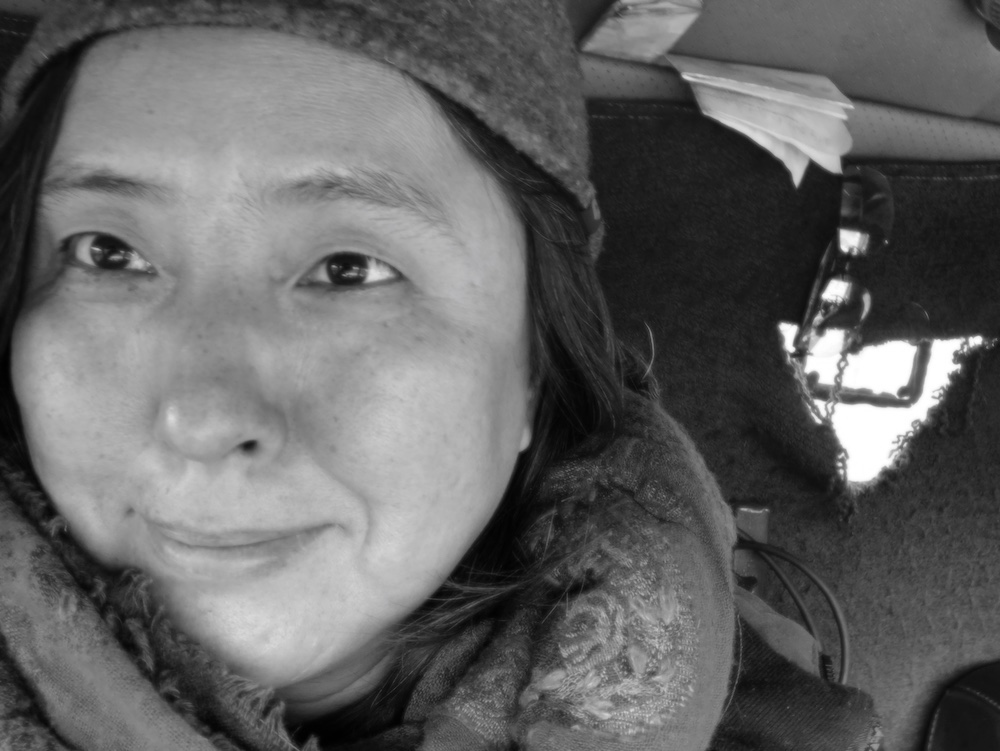
By Janyl Jusupjan
April 2026
I recently agreed to be interviewed for a scientific research project on the linguistic and social weight of Kyrgyz naming conventions. A friend had recommended me to the young researcher, and I welcomed the opportunity. For some time, I have felt the need to respond to a growing tendency in our intellectual circles—both in Central Asia and perhaps elsewhere: the mechanical application of Western feminist frameworks to our soil, with too little attention to the cultural landscape in which we actually live.
This is not a rejection of feminist thought. Through my films and writings, I have long engaged with questions of women’s empowerment and violence against women. But I am troubled by a mode of critique that isolates one cultural sign—such as a traditional female name—and reads it only as evidence of oppression, without asking what else may live inside it: history, emotion, survival, tenderness, myth.
I recently agreed to be interviewed for a scientific research project on the linguistic and social weight of Kyrgyz naming conventions. A friend had recommended me to the young researcher, and I welcomed the opportunity. For some time, I have felt the need to respond to a growing tendency in our intellectual circles—both in Central Asia and perhaps elsewhere: the mechanical application of Western feminist frameworks to our soil, with too little attention to the cultural landscape in which we actually live.
The argument goes roughly like this: names such as Burulsun or Uulbolsun are scars of patriarchy. Uulbolsun means “let there be a son.” Burulsun carries the sense of “let the change come”—that is, let a boy finally be born. In this reading, a daughter enters the world under the shadow of an absent male heir.
I understand why such names invite criticism. But I also feel that the current focus on them can become flattening, and at times distract us from more urgent threats facing Kyrgyz women and Kyrgyz culture alike.
The Erasure of the Authentic
If the goal of this critique is to liberate Kyrgyz girls, then we must ask a more difficult question: into what kind of identity are they being liberated?
In many urban settings, the old “placeholder” names are indeed disappearing. But they are not always being replaced by a consciously reclaimed Kyrgyz strength. More often, they give way to other dominant currents: globalized or Russified taste on one side, and an accelerating preference for religious naming on the other. In everyday life, one increasingly hears names drawn from those repertoires, while older Kyrgyz naming traditions recede.
This may seem minor to some. To me, it is not. It reflects a deeper fragility: a weakening of confidence in our own cultural forms. It is often easier to critique a traditional name than to defend the Kyrgyz language itself, or to confront femicide, domestic violence, or the pressure placed on women to become a tokol—a second or later wife in a polygamous household, often under the guise of religion.
I do not say this to silence critique. I say it because critique without context can become its own form of blindness.
The Dream of the Khanjar
My own name, Janyl (Жаңыл), carries within it the idea of mistake—of error, of a wrong step. A mechanical reading of it would suggest that I was named as a sign that the “mistake” of another girl should not be repeated. But that reading misses entirely the spiritual and emotional weight my name carried for my mother.
I never felt like a mistake.
My mother’s choice was shaped by a recurring dream. Before my brother’s arrival, she dreamt of a khanjar, an elegant dagger once worn by horsemen and warriors. Before my sister, she dreamt of a maki, a small folding knife used at the table and in daily life. When she was pregnant with me, she dreamt of the khanjar again. I was not a disappointment. I was a surprise of timing, mistaken for the boy the dream seemed to foretell.
When I was born in our remote village on the Kyrgyz-Chinese border, my mother was told that relatives had come to greet her. She looked out the window and saw eight men on horseback, dressed in full nomadic attire: heavy wolf-fur hats, thick coats of sheep and fox skin. It was as if the dream of the khanjar had stepped into the physical world.
That image stayed with me. It made me feel important. I was not the maki, the little utility blade. I was the khanjar.
I was the youngest and most beloved of my mother’s daughters. As she lay dying at eighty-five, she told me: “I am content with you. You took good care of me.”
If I ever felt uneasy as a child, it was not because I believed I had arrived in place of a boy. It was something much more ordinary: the vanity of a girl who later went to the city and found her name old-fashioned beside the Elmiras of the schoolyard.
And yet names have long echoes. After me, a boy was indeed born—Kubanych, “Happiness.” So perhaps there was some charm in the name Janyl after all. But he died, and my elder brother remained, in my mother’s words, her “only child.” In Kyrgyz, as so often, the word carries more than one life inside it: it means both child and son, but also the sole heir, the one who remains.
There is another twist to my name. People often call me Janyl Myrza—the name of an epic Amazon-like heroine, a woman who protected and fed her tribe. She belongs to an older world in which women, too, rode horses, defended their people, and carried authority. A woman of strength, not lack. That, too, lives inside my name. I have often thought that this name asks something of me: to go far, to endure, and to bring stories back. From the high Pamirs to the dying edge of the Aral Sea, across harsh landscapes, that is what I have tried to do.
Reclaiming the Seven Mothers
Today, a much more interesting discourse is beginning to emerge: the rediscovery of the Seven Ancestral Mothers, Жети эне.
For generations, nomads were expected to know their seven male ancestors, жети ата, by heart, while the female line remained obscure, unnamed, half-erased. I myself, for example, know only the name of my maternal grandmother, Gülü, who was a storyteller. I do not know the name of my paternal grandmother, nor the women further back. Now, some women and girls are beginning to trace their maternal lineage as well. To me, this is a far more profound act of empowerment than the simple denunciation of difficult names. I want my granddaughters to know more than I do. It is an act of recovery, of self-knowledge, of historical rebalancing.
In earlier times, the wish for a son expressed in names such as Uulbolsun or Burulsun was tied to material survival. In a world where property, status, and protection were structured through men, the absence of a male heir could mean a harsher and poorer life for an entire household. That reality should not be romanticized. But neither should it be stripped of context and reduced to a single ideological reading.
Today, the situation is different. Kyrgyz women are educated, economically active, and often carry families on their shoulders with a strength that even men themselves sometimes acknowledge with admiration. The older order was not always experienced as a simple war between men and women. It contained patriarchy, yes, but also partnership, interdependence, female endurance, authority, and care that do not fit neatly into ready-made binaries.
I have begun a series titled 40 Girls (Qyrk Kyz), inspired by the myth that the Kyrgyz nation descended from forty girls. I already have five stories in mind, including that of my late sister’s grandmother-in-law, an extraordinary nomadic woman who lived for more than a century. Some men react defensively to this myth. I do not argue much with them. I smile and continue.
My current work, whether in writing or film, returns to the same root: the preservation of Kyrgyz cultural memory.
If we lose the names of our ancestors because we find their origins too troubling, too impure, or too incompatible with external categories, then what remains of us?
My name is Janyl-Жаңыл. It carries the elegant weight of the khanjar. Perhaps the khanjar I carry today is no longer made of steel, but of words, image, and cut. It is mine.
———–
Janyl Jusupjan is a documentary filmmaker and writer. Her films include Atirkul in the Land of Real Men, an ironic critique of the contemporary condition of women, and other feature documentaries. She is also the author of Топоз, УАЗ & БИЗ (Yak, UAZ, and Us), a book of stories about Kyrgyz of Murghab in Tajikistan’s High Pamirs.